

Setting boundaries with children can be surprisingly difficult.
You tell your child that screen time is over, and suddenly there is an argument. You ask them to finish something before playing, and they insist that they should be allowed to do it later. You try to give them more freedom as they grow, only to wonder whether you have actually given them too much.
At the same time, many parents do not want their homes to feel like a constant list of rules. They want their children to have a voice, make choices, and become independent, but they still need to provide structure and know when to step in.
Finding that balance is one of the hardest parts of parenting.
Boundaries Are More Than Rules
A boundary tells a child where a limit is. It can involve screen time, household responsibilities, respectful behavior, safety, privacy, or how family members treat one another.
The difficult part is that a boundary is rarely just about the rule itself. Parents also have to decide:
- what the child is capable of handling independently
- which situations actually require a firm limit
- how much explanation is helpful
- what to do when the child disagrees
- when to hold the boundary and when to reconsider it
That is why simply telling parents to “be consistent” does not always answer the real question.
When Setting Limits Turns Into a Power Struggle
A boundary can be completely reasonable and still lead to an argument.
The child wants something. The parent says no. The child asks again. The parent explains. The child argues with the explanation. Eventually, the original limit gets buried under a much bigger disagreement.
After enough of these moments, parents can start taking one of two approaches. Some become much stricter because they feel that being firm is the only way to regain control. Others start avoiding limits because they are tired of fighting.
Neither response really solves the underlying problem.
The Parent You Aspire to Be Takes a Different Approach
The Parent You Aspire to Be by Miles Carter explores the difficult middle ground between being too controlling and being too permissive.

Instead of treating boundaries as a simple matter of enforcing rules, the book looks at how children respond to limits, how parents communicate those limits, and what may be happening underneath the conflict.
That perspective matters because the same boundary can produce very different reactions depending on the child and the situation. A child may be testing how much control they have. They may be frustrated by losing something they want. They may feel that a parent is not listening to them. Or they may simply need clearer expectations.
Understanding that difference can help parents respond without automatically turning the moment into a battle.
Being Firm Does Not Have to Mean Being Harsh
One of the more useful ideas in healthy boundary-setting is that firmness and harshness are not the same thing.
A parent can say no without yelling. They can correct behavior without humiliating a child. They can keep a rule in place while still acknowledging that the child is disappointed or angry.
This can sound simple, but it is much harder to do in the middle of a conflict.
The Parent You Aspire to Be uses real-life situations to show the difference between approaches that tend to escalate difficult moments and responses that are more constructive. The book does not stop at explaining what parents should avoid; it also offers practical ways to handle the situation differently.
Why the Way You Set a Boundary Matters
Imagine a parent who says, “Because I said so,” every time a child asks why they cannot do something. The rule may be perfectly reasonable, but the conversation can quickly become about control.
Now imagine a parent who explains the boundary clearly, listens to the child’s objection, and still keeps the limit in place.
The child may remain unhappy. That does not mean the boundary failed.
Children do not always need to agree with a boundary for it to be useful. They need to know what the limit is, understand what is expected of them, and gradually learn how to handle situations they do not like.
Healthy Boundaries Leave Room for Independence
As children grow, parents have to make a difficult adjustment: the child needs more control over their own life.
That can mean allowing them to make choices, solve problems, manage responsibilities, and experience reasonable consequences. Holding on to every decision may make things easier in the short term, but it can also prevent children from developing confidence in their own judgment.
Healthy boundaries are therefore not about controlling more. They are about knowing which decisions belong to the parent and which ones the child can begin to own.
That balance is one of the areas The Parent You Aspire to Be explores in a practical way.
What Makes This Book Useful for Parents
A lot of parenting advice sounds good until you have a frustrated child standing in front of you.
“Set boundaries.”
“Stay calm.”
“Give your child choices.”
The challenge is knowing what those things actually look like in a difficult moment.
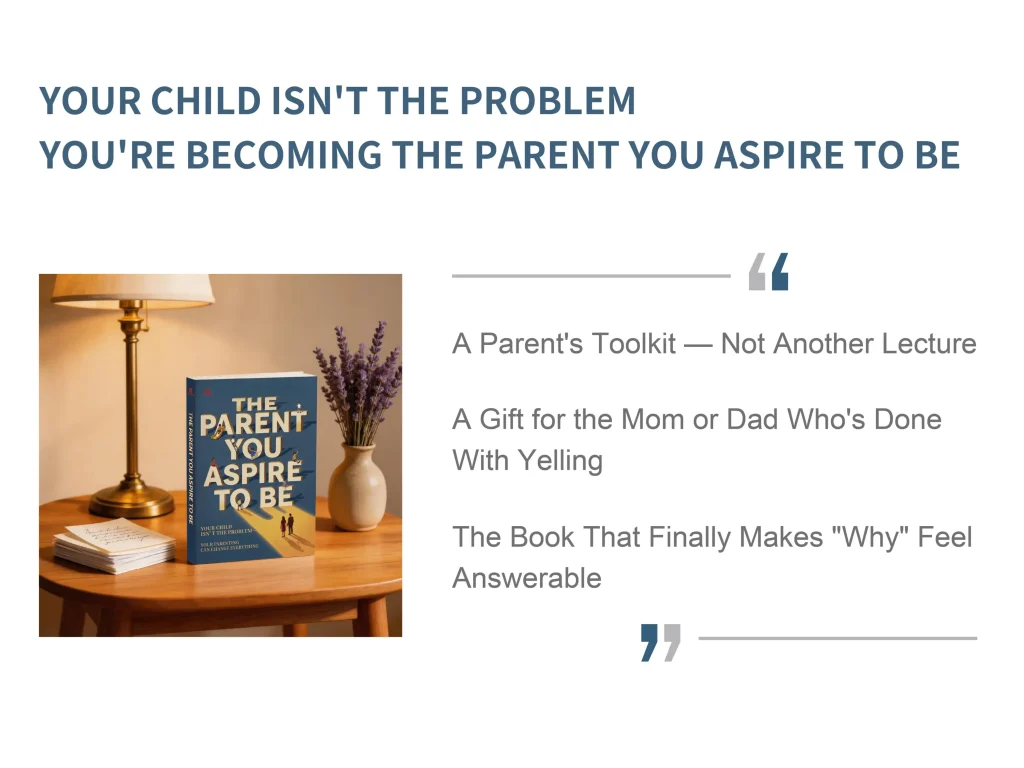
The Parent You Aspire to Be focuses on real family situations and compares unhelpful responses with more effective alternatives. It then gives practical steps that parents can apply rather than leaving them with a general principle and no idea what to say or do next.
That makes it easier to connect the ideas in the book with the conflicts that happen in everyday family life.
You Are Not Trying to Win Every Argument
A healthy boundary is not successful because a child happily agrees with it.
Sometimes your child will still complain. They may think the rule is unfair. They may test it again tomorrow. That is part of growing up.
What matters is whether the parent can hold an appropriate limit without turning every disagreement into a personal battle. Children need opportunities to disagree, express frustration, and learn that a boundary can remain in place even when they do not like it.
That is very different from expecting children to obey because they are afraid of what will happen if they do not.
A Practical Read for Parents Rethinking Their Approach
Setting healthy boundaries is not about finding the perfect parenting style. It is about making thoughtful decisions about where children need structure, where they need more freedom, and how those two things can exist together.
The Parent You Aspire to Be by Miles Carter offers a practical way to think about those decisions. It helps parents look beyond the immediate argument and consider what they are actually trying to teach their child through the boundary.
For parents who are tired of choosing between being overly strict and constantly giving in, this book offers another possibility: clear limits, better communication, and enough room for children to gradually learn how to manage more of their own lives.



