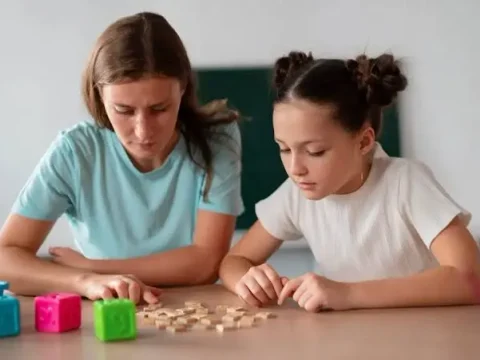
My son threw a wooden block at my head last Tuesday. I ducked. It hit the wall behind me and left a small dent. I remember thinking, this is not what I imagined parenting would feel like. I was scared of my own four-year-old. And I had no idea how to protect myself from a violent child who I also loved completely.
Here is the truth. You are not alone. This is far more common than anyone talks about at the playground. A child who punches, kicks, pulls hair, or flips furniture is not a bad kid. They are a kid whose nervous system has completely flooded. They cannot access the thinking part of their brain in that moment. Your job is not to teach a lesson right then. Your job is safety. Yours, theirs, anyone else in the room. Everything else comes later.

5 Immediate Steps to Protect Yourself From a Violent Child
- Scan and Remove Hazards. Before you even engage, do a two-second scan. Is there a heavy toy within reach? A cup of hot coffee? Move it or move yourself. I once missed a full water bottle on the couch. He threw it. It hit his baby sister. I never made that mistake again.
- Create a Physical Barrier. A couch cushion is your best friend. Hold it in front of you like a gentle shield. It absorbs kicks and thrown objects. It also gives you a split second to think. I keep a large floor pillow near the play area now. It looks decorative. It is not decorative.
- Protect the Vulnerable First. If there is a younger sibling, your first move is ALWAYS to secure them. Put the baby in a crib, a playpen, or behind a closed door for sixty seconds. A crying baby in a safe crib is infinitely better than a baby hit by a flailing four-year-old. Do this without guilt.
- Use the “Help Hold” Not a Restraint. If you must make physical contact, cross their arms gently across their chest from behind and hold them against your body. Sit on the floor with them if you can. Your goal is not to pin them. It is to contain the flailing so no one gets hurt, yourself included. Watch their head. A backward headbutt can break your nose. I know someone it happened to.
- Remove Yourself If Needed. If your partner is not home and you are getting hurt, leave the room. Close the door. Hold it shut from the outside if you have to. Stand in the hallway and breathe. He will scream. He will kick the door. But he is safe in a childproofed space. You are safe. The baby is safe. That is a win.
Why Does My Child Get Physically Violent During Tantrums?
Understanding the “why” does not excuse the hitting. But it does help you stop personalizing it. Which is crucial if you want to stay calm enough to protect yourself.
A four-year-old’s brain is still building the pathways that connect big feelings to words. When something triggers them, a cancelled playdate, a delayed snack, the wrong color cup, their amygdala fires. Cortisol floods their system. They enter a fight-or-flight state. They are not choosing violence in the way an adult understands choice. They are reacting from a primitive part of the brain that has exactly three options: fight, flight, or freeze.
Your kid chooses fight. That is terrifying. But it is also, in a strange way, a sign they feel safe enough with you to completely fall apart. The problem, of course, is that their safe person becomes their punching bag. Knowing this does not make the bruises hurt less. But it might help you stop asking the painful question: “Why does my child hate me?” He does not hate you. He hates the feeling inside him and you are the closest target.
Tracking when these episodes happen can reveal patterns that let you intervene earlier. A friend of mine realized her son’s worst attacks happened within ten minutes of her nursing the new baby. Every single time. He was not jealous in an abstract sense. He was saying, in the only way his flooded brain could: “I need to know I still exist to you.” Once she saw the pattern, she started setting him up with a special activity BEFORE nursing. The attacks dropped by half.
How to Protect Myself When My Child Attacks Me: The Safety Protocol
This is the practical section. What to actually DO in the moment when your four-year-old is coming at you with fists raised and screaming. I am going to give you a protocol you can practice in your head so it becomes automatic.
Step One: The Verbal Boundary
Say it once. Calm voice. No yelling. “I will not let you hit me. I am moving away to keep my body safe.” That is it. One sentence. Do not launch into a lecture about kindness. Do not ask “Why are you doing this?” He cannot tell you right now. Words are fuel on this fire. Say the boundary and move.
Step Two: The Physical Defense
You are allowed to block. You are allowed to dodge. You are allowed to hold a cushion between you. You are not being a bad parent by protecting your face. A pediatric therapist I respect once told me: “Never let a child successfully hit you if you can help it.” Not because you are teaching them a lesson in that moment. Because succeeding at hitting you teaches their brain that hitting works. It gets a reaction. It releases the pressure. Next time, the hitting will come faster and harder.
Step Three: The Safe Zone
Have a designated safe zone for your child. Ideally their bedroom, stripped of anything dangerous. A hook-and-eye latch on the outside of the door, high up where they cannot reach. This is not punishment. This is a container for the storm. You say: “I can see you are not able to control your body right now. I am going to keep everyone safe by giving you space. I am right outside the door. I will open it as soon as you are ready for a hug.”
Then you close the door. You latch it. You slide down the wall and you sit there. And you let him rage. You do not engage with screaming through the door. You wait. The first time I did this, my son screamed for twenty-two minutes. I timed it. The next time, twelve minutes. The time after that, four minutes. He learned that violence does not bring me closer. It buys him separation. And what he really wanted, underneath all that fury, was connection.
The “Safety Reset” Ritual
After the storm passes, there is a window. A brief, precious window where the cortisol recedes and your child is soft again. Do not waste this window on consequences or lectures. Use it for connection.
I call it the Safety Reset. It has three parts.
First, physical reconnection. A long hug. Not a quick pat. Sit on the floor and hold him. Rock a little if he will let you. Say nothing. Just breathe together.
Second, name what happened without blame. “Wow. That was a really hard moment. Your body had so many big feelings it wanted to hit and throw. My body felt scared. But we are both safe now.” Use “your body” language, not “you” language. “Your body wanted to hit” instead of “You hit me.” It is a subtle shift that reduces shame.
Third, repair any damage TOGETHER. If he flipped the garbage can, you both pick it up. If he threw toys, you both collect them. You help. You do not stand over him demanding he do it alone. The message is: You made this mess because you were overwhelmed, not because you are bad, and we fix things together in this family.
Is this a magic cure? No. He will rage again. But over time, the episodes get shorter. The trust deepens. And you start to feel less like a victim in your own home.
When the Younger Sibling Needs Protecting
The chaos multiplier in these situations is almost always another child. The original post described a wife home alone, holding a 1.5-year-old while the four-year-old attacked. That is a crisis. Here is the script for that exact scenario.
You are holding the baby. Your four-year-old starts to escalate. You do not wait for the first hit. You immediately, calmly, walk to the nursery. You put the baby in the crib. Baby cries. That is okay. Baby is safe. You close that door. Now you have two hands free to manage the four-year-old. You have removed the most vulnerable person from the equation. You are no longer outnumbered.
Practice this sequence mentally when things are calm. Visualize the steps. It will feel unnatural the first time. You may feel like you are abandoning the baby. You are not. You are prioritizing safety in a triage situation. The baby cannot be hurt in a crib. You can be hurt. The four-year-old can hurt himself. Address the most immediate danger.
When You Are the Target and You Are Alone
There was a phase where my husband traveled for work. Three nights a week, it was just me and two kids under five. My son saved his worst attacks for bedtime, when I was tired and touched out and had no backup. I learned some things.
I learned to wear my hair in a bun, not a ponytail. A ponytail is a handle. He grabbed it once and pulled me off balance. I fell. He fell on top of me. It took minutes to untangle us.
I learned to keep my phone in my back pocket at all times. Not to call anyone, necessarily. Just to know I could.
I learned that locking myself in the bathroom for two minutes while he raged outside the door was not failure. It was strategy. I would sit on the edge of the tub, take five deep breaths, and remind myself: He is not giving me a hard time. He is having a hard time. Then I would open the door and say, “I am ready to be with you now. Let’s try again.”
The most important thing I learned? You cannot protect yourself from a violent child if you are running on empty. The protection starts hours before the tantrum. It starts with a snack at 3pm whether he asks for one or not. It starts with ten minutes of rough-and-tumble play after daycare to reconnect. It starts with a consistent bedtime that leaves margin for your own nervous system to recover. Safety is not just physical. It is logistical.
FAQ: Protecting Yourself From a Violent Child
How do I protect myself from a violent child without hurting them?
Use defensive, not offensive, movements. Cushions as shields. Crossed-arm holds from behind. Never grab an arm or leg and twist. If you are unsure about physical techniques, ask your pediatrician to demonstrate a safe holding position. Many are happy to show you.
At what point should I seek professional help for my violent child?
If the violence is causing injury to you or others, or if the episodes happen more than a few times a week, talk to your pediatrician. Ask for a referral to an occupational therapist. OTs are often more accessible than behavioral psychologists and can assess for sensory processing challenges that fuel explosive behavior.
How can I protect myself from a violent child when I also have a baby?
Secure the baby first. Always. Put the baby in a crib or playpen. Even if the baby cries. A safe crying baby is better than an injured baby. Once the baby is contained, address the older child with both hands free.
Is it normal for a four-year-old to be physically violent toward parents?
It is more common than parents admit. Many four-year-olds go through a phase of hitting, kicking, or throwing. The question is not whether it is “normal” but whether it is happening frequently and intensely enough to warrant support. Trust your gut. If you feel unsafe in your own home, it is enough of a problem to seek help.
Sources: In her book The Whole-Brain Child, Dr. Tina Payne Bryson explains how a child’s “downstairs brain” takes over during tantrums, making logic impossible. Ross Greene’s work in The Explosive Child offers a framework for understanding that kids do well when they can, and lagging skills cause explosive behavior. The American Academy of Pediatrics provides guidance on managing aggressive behavior through consistent, calm limit-setting.
One last thing. The fact that you are reading this, searching for how to protect yourself from a violent child, means you are still showing up. You are still trying. You are scared and maybe bruised and definitely exhausted, but you have not given up. That is not nothing. That is actually everything.