
Some children have a hard time asking for help even when they clearly need it. They may sit with a difficult homework problem for an hour, become frustrated when they cannot finish something, or quietly struggle with a task rather than tell an adult they are stuck. When a parent asks, “Do you need help?”, the answer may still be a quick “No, I’m fine.”
For parents, this can be confusing. You may be thinking, “Why won’t you just ask me?” But for some children, asking for help feels like admitting that they cannot do something on their own. The issue is often less about whether they need help and more about what asking for help means to them.

Why Is Asking for Help So Hard?
A child can want to succeed and still be uncomfortable admitting that they are struggling. They may worry about getting something wrong, disappointing an adult, looking less capable than other children, or being corrected once they admit they do not understand.
Sometimes the hesitation comes from past experiences. A child who has been repeatedly told to “try harder” may start believing that needing help means they did not try hard enough. Another child may have learned that asking a parent for help quickly turns into a long lecture, lots of questions, or someone taking over the entire task.
So before focusing on getting your child to ask, it helps to understand what they are afraid will happen when they do.
Watch What Your Child Does Instead
Children who struggle to ask for help do not always look obviously dependent. In fact, some appear extremely independent because they insist on doing everything themselves.
Look for patterns such as:
- Your child gets increasingly frustrated but refuses assistance.
- They say “I don’t know” or “I can’t” but still will not explain what they need.
- They hide mistakes rather than telling you about them.
- They keep repeating the same unsuccessful approach.
- They become upset when an adult points out that they are struggling.
- They wait until the problem becomes much bigger before saying anything.
These behaviors can look stubborn, but sometimes they are signs that the child has not learned how to comfortably communicate, “I’m stuck.”
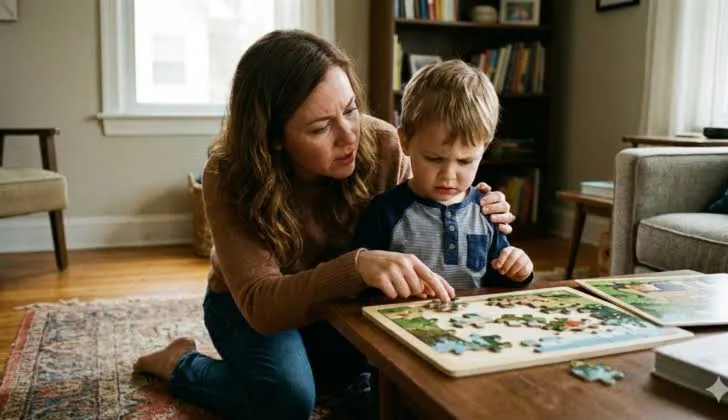
Make Asking for Help Feel Normal
Children are more likely to ask for help when they do not feel that asking changes how adults see them. That means parents have an important role in how they respond to ordinary moments of difficulty.
Try not to react as though the child has created a problem simply by needing assistance. A calm response such as, “Let’s figure out which part is difficult,” sends a very different message from frustration or surprise.
It also helps when parents talk naturally about their own need for help. Saying, “I don’t know how to fix this, so I’m going to ask someone who does,” teaches children that capability and independence do not mean doing everything alone.
Don’t Rush to Rescue
There is another side to this problem: parents who notice every struggle and immediately jump in.
Your child may be having trouble tying a shoe, solving a math problem, organizing a school project, or dealing with a disagreement. Before you have even been asked, you may already be offering instructions and fixing the problem.
Although this comes from a caring place, it can make it harder for children to learn when and how to ask for help themselves. Give them a little room to attempt the task first, while making it clear that support is available.
A simple message can be enough: “Try it for a bit. If you get stuck, you can ask me.”
Teach Them What Asking for Help Actually Looks Like
“Ask for help when you need it” sounds simple to an adult, but children may not know what that means in practice. They may not know how to describe the problem, who to approach, or what words to use.
Give them language they can borrow. They can say, “I don’t understand this part,” “Can you show me how to start?”, “I’m stuck,” or “Can you stay with me while I try it?”
This becomes particularly useful at school, where children may be expected to speak to a teacher rather than a parent. Practicing the words at home makes it easier to use them later when the situation feels uncomfortable.
Let Them Experience Help Without Losing Control
Some children avoid asking because they assume that once an adult steps in, they will lose ownership of the task. They may think, “Mom will just do it for me,” or “Dad will tell me exactly what to do.”
That is why the way you help matters. Instead of taking over immediately, ask which part they want help with. You might explain one step, ask a question that helps them think, or work beside them while they finish the task themselves.
The message becomes, “Getting help doesn’t mean someone else takes control. It means I get the support I need to keep going.”
Praise the Moment They Speak Up
You do not need to make a huge celebration out of every request for help. A simple acknowledgment can be more effective.
“You did the right thing by telling me you were stuck.”
That kind of response reinforces the behavior you want without making the child feel embarrassed for needing support. Over time, the child begins to associate asking for help with problem-solving rather than failure.
When a Child Continues to Avoid Asking
Pay attention when the fear of asking for help is affecting your child’s everyday life. A child may regularly avoid schoolwork, give up on activities they enjoy, hide problems from adults, or become extremely upset whenever they cannot do something independently.
In these situations, look beyond the behavior itself. Ask whether the child is dealing with strong fear of mistakes, low confidence, perfectionism, difficult experiences with adults, or another concern that is making it harder to speak up.
Depending on the situation, teachers, school counselors, or other trusted adults may also be able to notice patterns that parents do not see at home.
Help Them Learn That Needing Help Is Part of Growing
Children do not become independent by never needing anyone. They become more independent when they learn how to recognize a problem, decide when support is necessary, communicate what they need, and then continue participating in the solution.
That process takes practice. Give your child enough space to try things independently, enough support to know they are not alone, and enough patience to learn that asking for help does not make them less capable.
One day, the goal is not for your child to stop needing help. It is for them to be able to recognize, without shame or fear, when it is time to ask for it.



