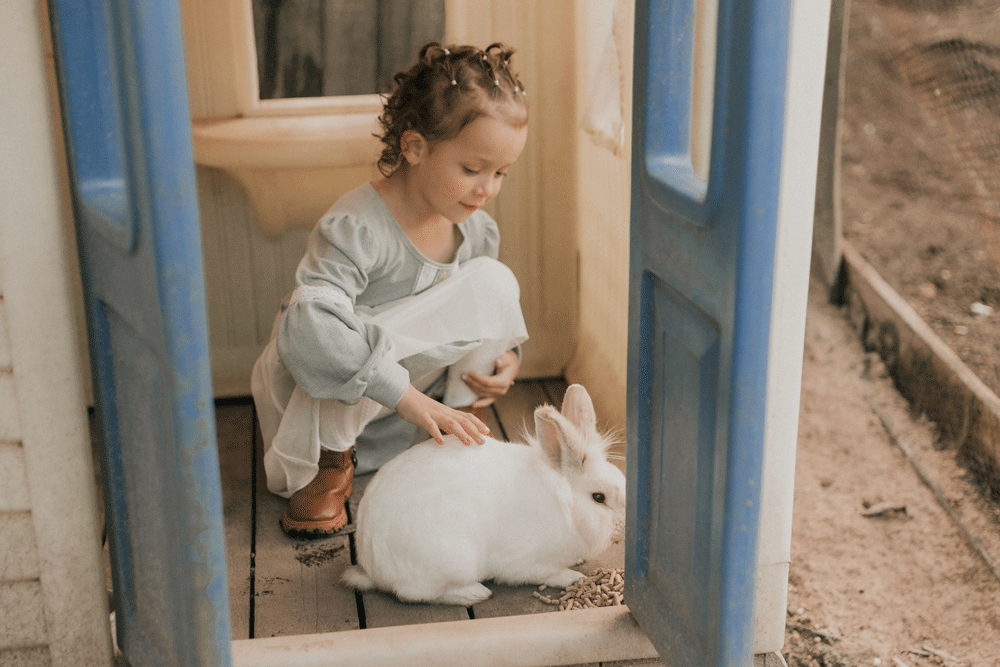
A friend called me last week, exhausted. She had spent the entire morning trying to get her three-year-old to finish a craft project. The paper was cut, the glue was out, the sequins were everywhere. But her daughter just wanted to sit and watch the glue drip off the spoon. “I kept thinking, ‘Just finish it already,'” she said. “And then I felt terrible for rushing her.”
I laughed. Not because it was funny, exactly. More like I recognized that feeling completely. I have been that parent. So many times.
The Problem We Don’t Talk About
Here is what I’ve noticed. We spend so much energy trying to teach our children everything. We want them to learn kindness, resilience, patience, gratitude. We read the books, we follow the experts, we prepare the lessons. And somewhere in that process, we forget something important.
We forget that we are also being taught.
The shift I want to talk about today is simple but not easy. What if the lessons we are trying so hard to teach are already living inside our children? What if the real work is not about pouring knowledge into them, but about opening our eyes to what they already know?
Three Practices That Changed How I Parent
1. Watch the Process, Not the Product
I used to be terrible at this. When my kids colored, I would look at the final picture and think about whether it was good enough. When they built with blocks, I would check if the tower was stable. I was always scanning for the result.
Then one day my daughter was painting at the kitchen table. She spent twenty minutes mixing colors. Blue and yellow became green. Green and red became brown. Brown and white became… something else. She never painted anything. She just mixed.
I almost said, “Aren’t you going to paint a picture?” But I stopped myself. I watched her face instead. She was completely absorbed. Her tongue was sticking out slightly. She was learning something I couldn’t name.
So I started sitting beside them differently. I don’t ask what it is going to be. I don’t suggest improvements. I just watch. Sometimes I ask, “What are you noticing?” or “What does that feel like?”
Children don’t separate process from product. The doing is everything. The mixing, the feeling, the watching, the trying again. That is where the joy lives.
If you find yourself rushing your child to finish something, pause. Sit down. Ask yourself what you might see if you stopped looking at the end result. Your child might be teaching you how to be present.
2. Let the Ordinary Surprise You
My son once spent forty minutes watching an ant carry a crumb across the patio. Forty minutes. I kept thinking about all the things we could be doing. The zoo was open. The library had story time. We had snacks to pack and laundry to fold.
But he would not move. Every time I tried to redirect him, he said, “But Mom, look. It keeps going.”
So I looked. And I kept looking. Eventually, something shifted in me. The ant fell off a leaf and got back up. It went around a rock instead of over it. It paused, then kept going. My son was not just watching an ant. He was watching persistence. He was watching problem-solving. He was watching something small do something big.
I started letting go of the schedule. When my daughter finds a puddle, we stop. When my son wants to watch the clouds, we lie down. I tell myself that this is not wasted time. This is the time that matters most.
The same pancake recipe, the same walk to the park, the same game of hide and seek. Those are the things that build a life. Not the big trips or the elaborate plans. The ordinary moments we almost missed.
3. Stop Fixing Their Feelings. Just Be With Them.
This was the hardest one for me. When my child was upset about something small, I wanted to fix it. I wanted to explain why it was not a big deal. I wanted to make the tears stop.
But when I rushed to fix things, my child would get more upset. Not less. Because what they actually needed was not a solution. They needed me to see them.
My daughter once cried for ten minutes because her cracker broke in half. Ten minutes. My first instinct was to say, “It’s still a cracker. You can eat the pieces.” But instead, I said, “You wanted the whole cracker. And now it’s broken. That is disappointing.”
She looked at me. The tears slowed down. She said, “Yes. I wanted the whole one.”
I did not fix anything. I did not make the cracker whole again. But something shifted. She ate the pieces. And she hugged me.
Now when my kids are upset, I don’t jump to problem-solving. I don’t say, “It will be okay” or “Don’t worry about it.” I say things like, “That is hard” or “I can see why you feel that way” or “I am here with you.”
Everyone wants to feel seen. Not fixed. Not coached. Not redirected. Just seen.
A Gentle Ending
So here is what I want to say to you. You are probably trying really hard. You are reading the books and following the advice and doing your best. That is good. That is important.
But maybe you can also open yourself up to what your children are teaching you. They are not empty vessels waiting to be filled. They are whole people with their own wisdom. Wisdom about joy and presence and connection. Wisdom we have forgotten somewhere along the way.
Your child is not giving you a hard time. They are showing you a different way to live.
Every time your child calls your name, they are not just asking for something. They are saying, “I am here. Are you here too?”
The answer does not have to be perfect. It just has to be present.